Showing posts with label Evolution. Show all posts

13 March 2010

The Unbroken Thread


So now there is a fourth "symphony of science" by John Boswell, this time with David Attenborough and Jane Goodall, with the poshumously peripatetic Carl Sagan. Here are some of the best lines:

"Those are some of the things that molecules do, given 4 billion years of evolution." [Sagan]
"Its a very wuzzy line and it's getting wuzzier all the time." [Goodall]
"Our planet is, as far as we know, unique in the universe; it contains life" [Attenborough]
"Its continued survival now rests in our hands." [Attenborough]

"There's an unbroken thread from those first cells to us." This is Sagan's line and it is taken as the theme of this symphony. That's what we've learned about the genetic code: that while it is ever changing, it is also eternal. It's as if a notebook was opened at the creation, and it has been gathering notes continuously ever since. The number of copies has expanded, seemingly without limit, though in practice there are of course limits, especially on each genomic variation. But overall, the notebook proliferates and each new note adds to the storehouse of information about what works and what does not work for life on this planet. And each individual has their own copy and makes contributions that are realized in new copies of the genome. Darwin may not have known about the molecular machinery, but he certainly grasped the essence of the situation when he wrote:

"There is grandeur in this view of life..as the Earth has gone on cycling... from so simple a beginning, endless forms most wonderful and beautiful have been, and are being evolved." -- Charles Darwin, 1872

27 October 2009

The Symphony of Science


Well, it's been a while, but I haven't gone away. These two pieces of remix work by John Boswell, who has a home page here, is something special. It echoes and greatly amplifies some materials I have linked from the opening of the Cosmos series (lower right column), but Boswell has added music in a very pleasing way, at least to me. And millions of others agree, as these short music videos are wildly popular on YouTube. In any case, it is really wonderful to see such creativity invested in Cosmos, and also the really great segments added in from Richard Feynman's interviews, from Bill Nye's material, and from Neil Tyson's work. I hope you enjoy these if you stumble in here, and let's hope that these materials create a big wake in the universe, of people who have been "turned on" to science and it's spiritual side.

10 February 2007

Teach the Revolution!


The state of dialog between evolutionists (Darwinists in the view of creationists) and creationists (IDiots in the view of evolutionists) is truly terrible, but perhaps that's the way it should be. Perhaps the entire ID schtick is as vapid as claimed, and they should be given no quarter whatsoever. They come on so reasonably with plausible sounding critiques of Darwinian natural selection, one is tempted to take them seriously, or at least I have been for about four years now. But my recent explorations have pretty much cleared up any doubts I may have had about whether ID critiques of natural selection need to be taken seriously. They don't. These are the quibbles of people with ulterior motives, and don't stand up to scrutiny at all. Even if they did, their source pretty much disqualifies them, since these folks have no serious interest in improving our understanding of life, only in tearing it down.

So it is fair to conclude that science and education simply cannot afford the indulgence of "teaching the controversy." But I would carry it a step farther than simply ejecting creationism and ID from our schools. In my view, we should be teaching the revolution in human thought that took us from creationism to natural selection. Our best physics curricula teach the revolution in astronomy that wrenched us from the geocentric Ptolemaic universe to the heliocentric Copernican revolution, forever changing our understanding of our own place in the universe. Similarly we should teach the revolution in biology that took us from creationism to the Darwinian revolution. The change has been even more transformative and religiously-disturbing in this case, and clearly we are still struggling with it, but the time has come to stop treading lightly and respectfully toward religion on this and to make a point of stating the case for science. So yes, by all means let us teach both creationism and natural selection in our schools, but let us put them in their proper perspective and say clearly and emphatically that creationism has been superseded in modern thought, with repercussions that religious believers must confront and reconcile with their dogmas.

There should no claim here that Darwinian evolution is the final story, but neither should there be a mistaken impression given that there is any possible return to the idea that a supernatural intelligence might help us explain our world and how we came to it. We can marvel at the incredible grandeur and exquisitely detailed complexity of the universe and life within it, and at the universal laws that so clearly regulate it throughout. But we will gain no useful wisdom for this world from the idea that we must eventually face a designer-creator in another.

So let's teach the revolution as the revolution that it truly is and not as a controversy. Still it is well to keep in mind Carl Sagan's Baloney Detection Kit, which includes: "Encourage substantive debate on the evidence by knowledgeable proponents of all points of view." Click the title or graphic of this post and then click: "Ideas"

13 January 2007

Revisiting the Weasel Experiment

Richard Dawkins' interesting computer simulation of natural selection with random variation demonstrates a startling ability that, "at first exposure, is every bit as counterintuitive as quantum mechanics." [Scott Maxwell]. It has been criticized by intelligent design folks on grounds that: 1. the answer is known ahead of time so of course it gets the right answer, and 2. unrealistic mutation probabilities are used in the demonstration, and 3. random variation will cause more damage than improvement, resulting in catastrophic results. Objection 1. is that of someone who simply will not trust the experimenter, but can be addressed by defining a "fitness function" that turns the goal into an objective optimization problem. Objection 2 can easily be adjusted. Objection 3. reflects some subtleties that are too often glossed over by evolutionists, including Dawkins. This post is to show that the Dawkins demo has been put online, and that updates have been made to the demo that allow it to be much more closely analogous to real natural selection. In addition I'll point to some other software that gets even more realistic, evolving 2D graphics in a method that observes a distinction between genotype (algorithmic data) and phenotype (translation to graphical products).

First, here is the original Dawkins weasel experiment, except that you can substitute whatever string of data you would like as the target and then watch the process converge on the answer, typically in less than 100 "generations." It's too bad one could not continuously update the target string and watch the selection process demonstrate adaptation, as it dynamically tracks the changing conditions. Ah well, that will come in time.

But here is a better version of the weasel program, especially in the sense that you can download the source code and play with it yourself, or just read it to see what is going on. This one reveals a subtle point that is the source of creationist misunderstandings of this program. The figure shows that quite a large population of "critters" is generated in the process of selecting for the target output string. This is essential because many "bad" mutations occur that are deselected. This isn't stated clearly in Dawkins' original description or the instance described above. It is something that the ID folks believe to make a solution impossible, but clearly it does not do that, though it does require more deselection than is obvious from reading Dawkins or the previous online program.

Next is the much more realistic case where we have a specified population of random strings that are being randomly altered at a specified rate. Moreover, pairs of the strings are sexually mated to produce offspring strings in each generation, as random mutation proceeds. Several selection options can be exercised, as well as several options for the sexual merger. The mutation rate and population rate can be varied as much as one likes, slowing the process to a crawl if desired. So much for objection 2. Again, it would be nice if the target string could be varied as the process proceeds, so we could watch adaptation to new guidance being reflected in the results.

Finally, we have a more complex but visually appealing piece of software that implements a more realistic simulation in which a genotype is set up consisting of parameters controlling diverse graphics primitives and techniques. Each genotype translates to a phenotype as a 2D graphic panel. The user can then exert intelligent selection by either asexually or sexually breeding new generations of graphics, manipulating the graphical products toward whatever s/he may choose. Warning: this gets considerably more involved, though this program insulates one from the details so that everything is accomplished by point and click selection and no actual graphical engineering is required.

So there we have it in gradually more complex forms; a compelling demonstration of the power of selection with random variation, as a way of exploring multi-parameter design spaces and searching for optimal solutions of whatever problem is chosen, whether it be the matching of a particular string of characters, or the creation of a desired graphical image. So much for objection 3.

Does anyone know of simulation programs like these designed to illustrate the criticisms of natural selection that have been made by the intelligent design community? I would like to see what kinds of demonstration can be made of the failure of natural selection to function as advertised. If so, please point to them in the comments and I will compare them with the above cases.

Further Reading:
More than you ever wanted to know can be found in the Creationism Asserted and Creationism Rebutted links in the sidebar. However for a really definitive look at the matters discussed here, TalkOrigins can't be beat.

Intent, Intelligence, and Purpose in Design?

In response to an invitation to discuss that status of Intelligent Design in the UK, a Christian theist neuroscientist from Canada (Elizabeth Liddle) created a stir at uncommondescent.com (Bill Dembski's blog site, click title) by using Dembski's own arguments to show that natural selection is a form of intelligent design. Dembski had written that "by intelligence I mean the power and facility to choose between options--this coincides with the Latin etymology of “intelligence,” namely, “to choose between”. Liddle pointed out that, by that definition, natural selection must be credited as an intelligent process, and therefore, natural selection is a clear example of "intelligent design". Needless to say, this did not go over well and a lengthy debate ensued with the so-called "moderator" of uncommondescent, DaveScot, during which Liddle at one point pointed to a story she wrote her son. Liddle was polite, good natured about the sparring, and indefatigable. After some long rebuttals of his standard arguments, for which he did not appear to have an answer, DaveScot summarily banned her from the site. "[Febble] doesn’t understand how natural selection works to conserve (or not) genomic information yet insists on writing long winded anti-ID comments filled with errors due to lack of understanding of the basics [and ] is just not a constructive member.", after the following exchange:

DaveScot suggested that intelligence must also include planning for the future. Liddle conceded that natural selection does not plan for the future in the sense of running model scenarios and choosing the one that seems best, as in a chess game, for example. But she asserts that by remembering past mistakes and successes, natural selection is in some sense planning by using the strategies that worked best in the past. Her final statement before banning was:

"It may be described as “trial and error” learning, but that is a bit of a misnomer, as “trial-and-error” could just as easily describe random search. Trial-and-error learning involves, well, learning. It’s much more efficient than random search because you learn from your successes and your mistakes. Natural selection + replication with modification also learns from both its successes and its mistakes, which makes it moderately intelligent.

So the scale of intelligence begins with Dembski's simply "making choices", extends to "making informed choices" (based on a record of prior experience, kept in the DNA), and then culminates in "making choices based on models of future developments" which is where humans come in. This seems eminently reasonable, but does leave open the question of intent or purpose. I would have named things differently here. Choices reflect clear intent or purpose, in my opinion, but not much intelligence. So natural selection certainly expresses intent, as well as minimal intelligence per Dembski's definition. But natural selection with genotype replication brings note taking and documentation to bear, adding more intelligence to intent. And human theory and model making adds still more power to intent, allowing for the attribution of "purpose," and implying a longer view of things rather than just a preference for certain immediate results.

Comments on these definitions?

08 January 2007

Carl Sagan on evolution

From Cosmos - Carl Sagan on evolution

"Evolution is a fact, not a theory. It really did happen." We may not know fully how it happened yet, but there is no denying that it did. And we have participated in manipulating what happened as long as we've been around, with our inquiring minds wondering and exploring what we can accomplish, and emulating nature's trial and error.

19 December 2006

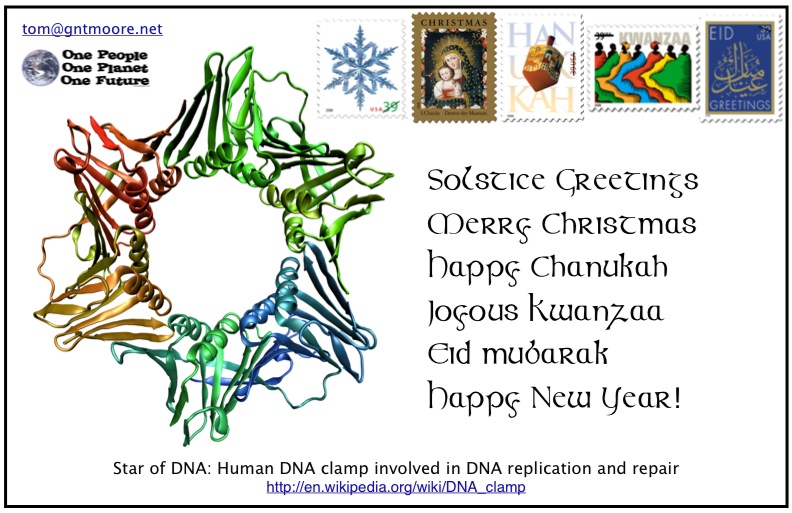
Star of DNA Sighted


This picture of the day from Wikipedia (17 Dec) really struck me, so I used it to make a holiday greeting card this year. It's a molecule consisting of three long peptide chains arranged into a star shape with a circular inner ring. It evidently plays a clamp-like role as it travels along a DNA molecule during replication, sort of a zipper function, if I get it correctly. According to the article, the clamp speeds the rate at which the unzipping/zipping of DNA occurs by a large factor. So this star shaped molecule (one might say "snowflake-shaped") plays a key role in human reproduction. The coloration used by the molecular modeling software to generate this visualization struck me as festive as well, as did the loopy structure of the molecular strings.