08 January 2007

Carl Sagan on evolution

From Cosmos - Carl Sagan on evolution

"Evolution is a fact, not a theory. It really did happen." We may not know fully how it happened yet, but there is no denying that it did. And we have participated in manipulating what happened as long as we've been around, with our inquiring minds wondering and exploring what we can accomplish, and emulating nature's trial and error.

07 January 2007

Engineering and ID

I've been mixing it up on the Uncommon Descent blog on ID. It's a bit frustrating because they are choosy about what they will pass through their moderation filter and the moderator tends to react rudely to dissenting views. Sometimes it seems that comments only get through for which they have a convenient rejoinder. But I have had some good interactions there. To their credit, they have moderated me though for an interesting exchange today.

The article and discussion are at the link attached to the title of this piece.

Brief synopsis:
The article says that engineers can appreciate ID because they engage in it every day and can see the design in nature more clearly than others.I claim that engineers do not design complex systems, but rather simple systems. When they get *truly* complex, the process becomes evolutionary.

DaveScot says this is the scotsmans fallacy (he should know!). So there.

I reply that *truly* complex is not subjective (as in the scotsmans fallacy) but defined as a system too complex to be practically predicted, citing Wolfram's "A New Kind of Science." When designs get complex, they have unintended consequences that cannot be predicted but can later be exploited by incorporation into an evolving design.

DaveScot says I still am committing a scotsmans fallacy and besides who the heck is Wolfram?

Some of the rest of the participants begin to engage on this, and I reply. One interesting line concerns intelligent selection, which is what happens with animal husbandry, or the guidance of complex system evolution by intelligent engineers.

DaveScot never actually engages on the points under discussion but rather makes a fuss about Wolfram being a crank, and accuses me of being a crank too. He gets pretty unfriendly and admonishes me to refrain from logical fallacies, or citing cranks, and says that he only allowed my posts because I work for NASA, "an organization for which he has the highest respect". Then, he commits what for me is an unpardonable offense: he edits the link I have provided in my personal profile to my web site, connecting it to my NASA site. I'm outta there...

06 January 2007

Logic and Naturalism

My Google alert for humanism and naturalism turned up a beautiful blog making a mathematical argument for the supernatural. Gødel's proof that mathematical logic requires some assertions to be made as axioms beyond proof, is claimed to prove the existence of the supernatural. But knowledge that something is incomplete does not tell us what would complete it. As Dawkins would say, "it has not been disproven that there is a teapot of fresh hot English Breakfast orbiting the Earth. But that is not a good basis for astronauts to plan a tea on orbit."

Corresponding to Godel's theorem, there is one important moral principle that is axiomatic and beyond proof, and that is the sanctity of life in the universe. Naturalists agree on this principle and share it with the adherents of most other moral codes. It requires no supernatural authority to recognize the importance of life in the universe. The problem is that many if not most religions qualify sanctified life with the adjective "human", and even more narrowly, human life of the right religious persuasion. Humans of other persuasions (or races, creeds, colors) are often defined to be subhuman, putting them outside the sphere of sanctity and making them eligible for execution when expedient.

The difference between supernaturalism and naturalism is that there IS abundant evidence, accessible to everyone, of the everything in the natural world. The natural world of reality is "that which doesn't go away when you stop believing in it" (Phillip Dick). This is an extremely powerful argument and there is nothing illogical or inconsistent about it.

Scientific "truth" is not that at all, but rather is our best guess, today, and will certainly be revised. Compare that with "revealed truth", i.e. dogma. But even dogma will be examined by science, and accepted when there is evidence for it. Science seeks only to "silence" claims for which there is no evidence, in favor of claims for which there is evidence, but then only until there is more evidence.

Regarding the blog comment on "non-theism": that's close to agnosticism, the assertion that there can be no knowledge of events to which we have no sensory access (like the period before the big bang). One is free to believe what one likes about things for which there is no evidence. They must be believed to be seen. Naturalism simply urges that we make life and death ethical decisions based upon what we know and agree upon (plus the axiom of the sanctity of life) rather than things some of us happen to believe but about which others may disagree without any possible (evidence-based) resolution.

More relevant here is "pantheism", which is the assertion that it is the universe itself to which we owe reverence and the attribution of divinity. Could there be a power more indifferent to mere humans; yet which is evidently responsible for the existence and the support of all life forms? Or a better basis for the sanctity of life? It's not the deity we want, too "red in tooth and claw" for our tastes in a personal God, but it's the deity we have, according to the available evidence.

"We are a way for the universe to know itself." -- Carl Sagan
21 December 2006

Carl Sagan, gone for "ten trips around the Sun"

Carl Sagan was one of the strongest and most enduring influences on my choice to pursue teaching and then science. His view of humans as "a way for the universe to know itself" echoed and extended themes I'd read in Alan Watts. Carl's many books and shorter articles guided and inspired me up through his untimely death. They shaped my interests and led me to specialize in the science of the solar system. Many were critical of what they saw as Carl's excessive participation in the cult of personality through the media. But from my perspective, Carl was the ultimate modern renaissance man, with interests that spanned the universe in a way that few others came close to expressing. He excelled not only in communicating the excitement of science to the general public, but also led a generation of scientists in seeing the broader relevance and impact of their work, helping us to get beyond the mentality of the cold war. David Morrison agrees. Carl is deeply missed.

There is a detectable web competition for the title of "Next Carl Sagan". It's a very tough act to follow on the world stage. But we do need others to tell us how wonderful is the world as revealed by science, how little we really need our illusions and superstitions, and how much more sound is a simple reverence for life and all the forces that have created it.

"We are made of star stuff." -- Carl Sagan

19 December 2006

Star of DNA Sighted


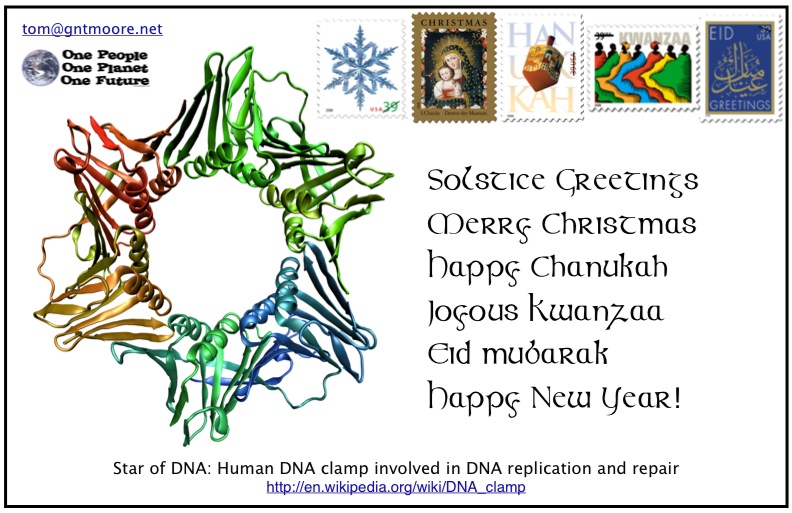
This picture of the day from Wikipedia (17 Dec) really struck me, so I used it to make a holiday greeting card this year. It's a molecule consisting of three long peptide chains arranged into a star shape with a circular inner ring. It evidently plays a clamp-like role as it travels along a DNA molecule during replication, sort of a zipper function, if I get it correctly. According to the article, the clamp speeds the rate at which the unzipping/zipping of DNA occurs by a large factor. So this star shaped molecule (one might say "snowflake-shaped") plays a key role in human reproduction. The coloration used by the molecular modeling software to generate this visualization struck me as festive as well, as did the loopy structure of the molecular strings.

09 October 2006

Leibniz and Spinoza

A recent book by Matthew Stewart: "The Courtier and the
Heretic", 2006, has proved most interesting. This paragraph from the introduction really struck me:

"..., the two greatest philosophers of the seventeenth century remain unsurpassed, and should perhaps be considered the twin founders of modern thought. We live in an age defined by its reaction to Spinoza and to all that he recorded in his philosophy. And there is no more compelling expression of this reaction than the philosophy Leibniz developed in the long years after his return from Holland (after visiting Spinoza). Contemporary debates concerning the separation of church and state, the clash of civilizations, and the theory of natural selection, to name just a few examples, are all continuations of the discussion that began in November 1676. Even today, the two men who met in the Hague stand for a choice that we all must make and have implicitly already made."

And a summary paragraph:

"... The two men who met in 1676 in fact represent a pair of radically different philosophical personality types who have always been part of the human experience. Spinoza speaks for those who believe that happiness and virtue are possible with nothing more than what we have in our hands. Leibniz stands for those convinced that happiness and virtue depend upon something that lies beyond. Spinoza counsels calm attention to our own deepest good. Leibniz expresses that irrepressible longing to see our good works reflected back to us in the praise of others. Spinoza affirms the totality of things such as it is. Leibniz is that part of us that ceaselessly strives to make us something more than what we are. Without doubt there is a little piece of each in everybody; equally certain is the fact that, at times, a choice must be made."

NB: Leibniz independently developed the calculus a bit later than Newton, and his notation won out eventually to become the one we use today. Spinoza the Jew who was excommunicated in his early 20s, has been credited with inspiring Thomas Jefferson and other Founders of the US Constitution in regard to the "establishment" clause and other key aspects of the constitution and bill of rights, as well as inspiring the perpetrators of the French Revolution, and the rest of the secular, liberal, democratic order of today.It's interesting to track these ideas back before 1776; which I don't recall my world history or philosophy classes ever having done. All this material from the book made The Pope's recent controversial statements about Islam reverberate loudly in my head. Nevertheless, caveat emptor is appropriate and one should perhaps have a look at some of the more negative reviews of this book as linked in the title of this entry. It may be that the scholarship is a bit lacking in this book, in the interests of spinning an entertaining tale.

HyperPage

I've posted a musing at the link on an idea that's been bugging me for a long time. We like to think we are pioneering new things with the internet tying humanity into a huge new network of information. But I hold that information is only part of the story, and we haven't yet begun to tie ourselves together with a common approach to processing information. That may require a new standard for processing algorithms, and a way to browse them, which I call HyperPage. Please have a look and comment here if you like.

02 September 2006

Spinoza, Credited

A public radio show (Speaking of Faith) recently featured Rebecca Goldstein, author of a new book on Baruch Spinoza, "Betraying Spinoza: The Renegade Jew Who Gave Us Modernity." It has reignited my interest in the original pantheist philosopher. I previously read his "Ethics", which I found pretty dense though intriguing.

It's amazing to me to see Spinoza credited as the inspiration for much of the enlightenment, inspiring the founders of the USA, and the separation of church and state, as a meme. To me, this is an incredible confluence of interests. The book has inspired quite a bit of commentary, including a review in the NYT. We recently passed the 350th anniversary of Spinoza's excommunication by the Jews of Amsterdam, around 28 July it seems.
Spinoza was cited by Einstein as having defined a God with which he could identify. Spinoza's God is the God of Nature, or in Einstein's view, the God of natural law. It's easy to appreciate that this was taken to be blasphemous in the 17th century.

Though the book is not in our library so soon after its release, I did find another book that may be as good, and certainly is of great interest if one seeks to know and understand Spinoza: "The Heretic and the Courtier: Spinoza, Leibnitz, and the Fate of God in the Modern World", by Matthew Stewart. Not content to chronicle Spinoza alone, Stewart casts a spell by comparing two figures who could not be more different: Spinoza the optician and lens grinder by day and philospher by night; Leibnitz the polymath prodigy who defends religioin against the tide of Spinoza's thinking, all the while harboring strong sympathies for Spinoza. More when I finish it...